One long read for a slow Sunday. This week we follow a single watt from the substation to the chip, and back out as heat. By the end, you will see why a modern AI hall is less a building full of computers than a power and cooling plant that happens to do math.
Why anyone should care about a watt
Data centers used about 415 terawatt-hours of electricity in 2024, roughly 1.5 percent of the world’s total, according to the International Energy Agency. The IEA expects that to more than double, to around 945 TWh, by 2030.
The US feels it more sharply. A Lawrence Berkeley National Laboratory report put data centers at about 4.4 percent of US electricity in 2023, or 176 TWh, and projected 6.7 to 12 percent by 2028. That spread is wide, and it is honest: nobody knows exactly how fast AI demand will grow, or how efficient the hardware will get.
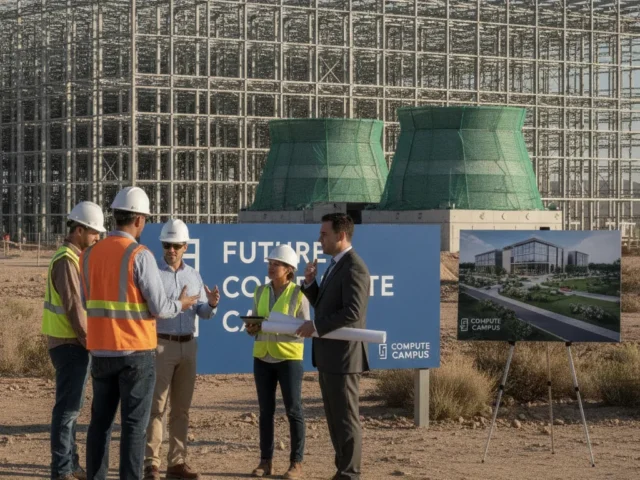
So when a proposal like the six-gigawatt campus in Cochise County, Arizona lands in front of a planning board, the argument is really about the path of that watt. Let’s walk it.
Stop one: the substation
Long-distance transmission lines run at very high voltage because high voltage means lower current, and lower current means less energy lost as heat in the wires. No server wants that voltage, so the first job is stepping it down.
Large sites increasingly get their own substation, which is why the first thing to rise on a big campus is often not a building but a yard of transformers and switchgear. It is also where many projects get stuck. A site can have land, money and chips and still wait years for a grid connection and the heavy equipment to use it. That is why you keep reading about campuses going up next to power plants: it shortens the trip.
Stop two: the safety net
Next, power runs through systems that keep the hall alive when the grid blinks. An uninterruptible power supply, usually built on batteries, covers the first moments of an outage. Backup generators are designed to take over for longer ones.
Each conversion here loses a little energy. AI training adds a fresh headache too. A cluster working in sync can swing its power draw sharply, and both the electrical gear and the grid have to tolerate that. A traditional server room mostly hums along. An AI hall can behave more like a single enormous machine that breathes in and out.
Stop three: the busway and the rack
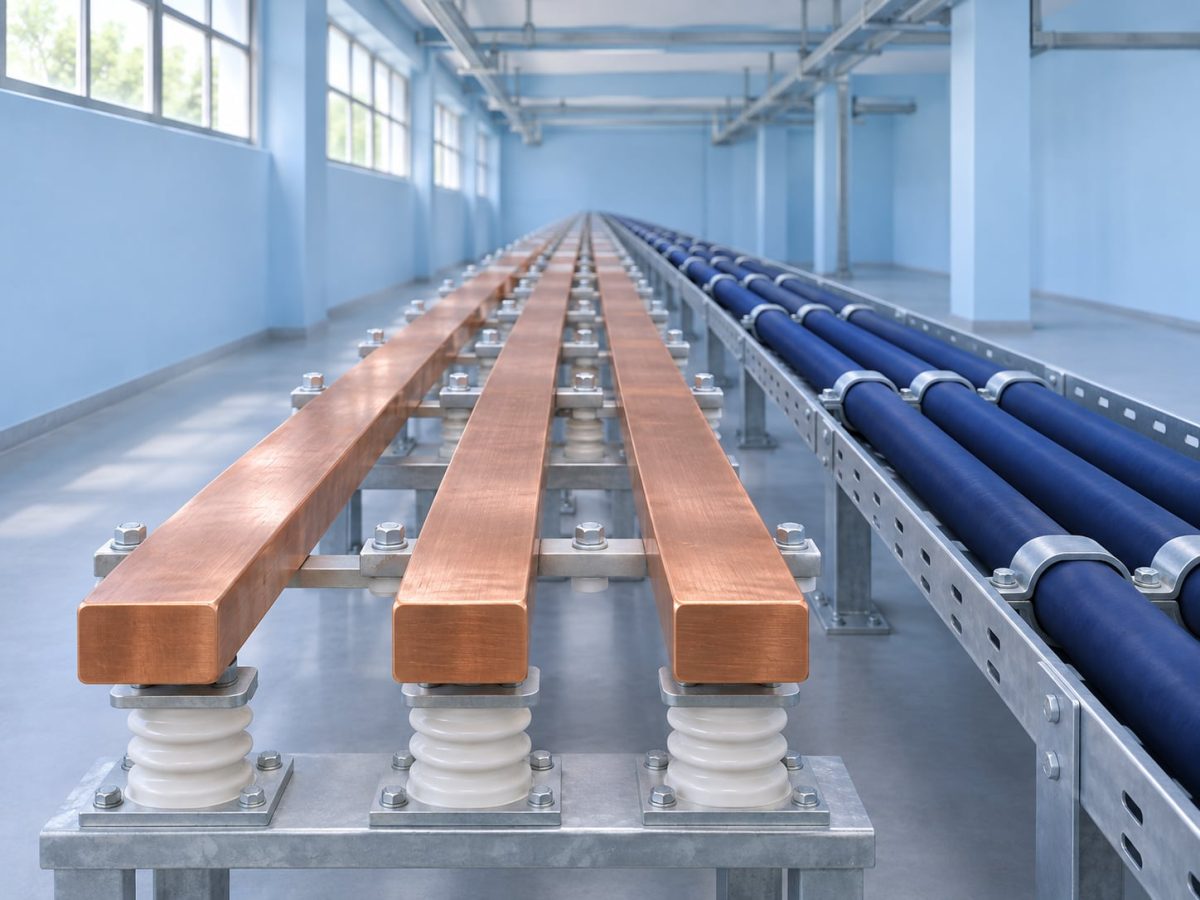
From the electrical room, power travels along overhead busways, which are essentially thick insulated metal bars, or through heavy cables, and then into the racks. Rack by rack is where AI breaks old assumptions. A rack of ordinary servers used to be a modest load. A rack full of accelerators packs far more power into the same floor space.
That concentration changes the building. Floors must hold more weight, cables get thicker, and designers spend real effort on simply getting enough copper to the right spot. It is an unglamorous constraint, and it is often the one that decides what fits.
Stop four: the last inch
Inside the server, a power supply converts electricity again, and voltage regulators sitting next to the processor bring it down to around one volt. Low voltage at high power means enormous current, which is why those final millimeters are among the hardest problems in the whole chain. Resistance in that last stretch wastes energy right next to the hottest part of the machine.
Then, finally, our watt does its job. It flips transistors, moves data to and from memory, and helps a model produce one small piece of an answer.
Stop five: everything becomes heat
Here is the fact that shapes all of it: practically every watt that enters a computer leaves as heat. Doing the math does not use up energy in any lasting way. So a 100-megawatt hall is also, in effect, a 100-megawatt heater, and that heat has to go somewhere continuously.
For decades the answer was air. Cold aisles, hot aisles, big fans. Air works fine at low density, but it holds very little heat compared with liquid, and today’s dense AI racks are pushing past what it can comfortably remove.
That is why liquid has moved into the rack. In direct-to-chip cooling, a cold plate sits on the processor and coolant carries the heat away to a coolant distribution unit, which hands it to a building loop. From there, it goes outside through cooling towers or dry coolers.
This step is a real trade-off, not a free win. Evaporative cooling towers are energy-efficient but consume water. Dry coolers save water but tend to use more electricity, especially on hot days. That is the choice behind the promise of dry cooling in the Arizona proposal: in a desert, water is the scarce resource, so the bill shows up as power instead.
The one number that scores the whole trip
The industry measures all of this with power usage effectiveness, or PUE: total facility energy divided by the energy reaching the computing gear. A perfect score is 1.0, meaning every watt reaches the IT equipment.
The Uptime Institute’s survey work shows the industry average stuck at a little above 1.5 for years. Google reports a fleet-wide 1.09 for 2024. In plain terms, for every watt of computing, the typical site spends about half a watt more on overhead, while a best-in-class fleet spends about a tenth.
PUE has limits. It says nothing about water, and nothing about whether the chips do useful work. Treat it as a score for the building, not for the AI inside it.
What to watch
Three things decide how much compute a site can really deliver, and none of them is the number of chips on order.
- Time to power. How long until the grid connection, or on-site generation, is real? Announced gigawatts and energized gigawatts are very different things.
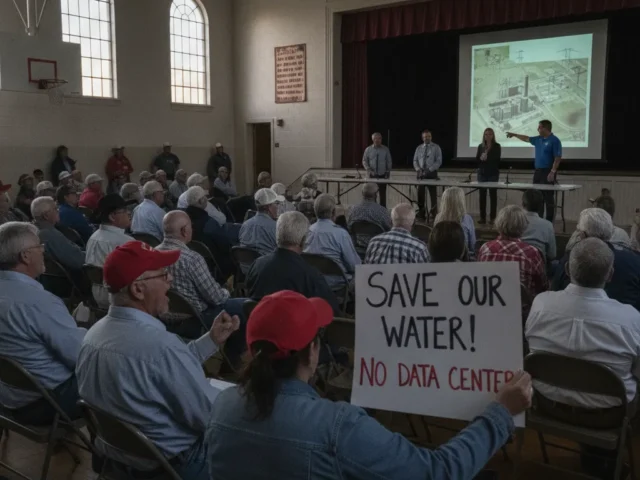
- Cooling choices. Local climate and water decide what is sensible. Expect these trade-offs to feature in every public hearing.
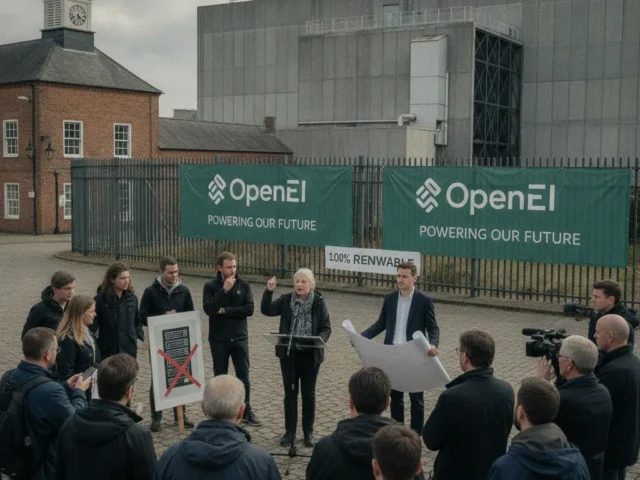
- Who pays. As sites grow, neighbors want to know whether their bills will rise and what they get in return. The physics is settled. The politics of the watt are not, and we will leave that fight to the planning boards.
Want to get a feel for the scale? Try our data center calculator and see how quickly accelerators turn into megawatts.
Sources
- International Energy Agency: Energy and AI, executive summary
- US Department of Energy: summary of the 2024 Lawrence Berkeley National Laboratory report
- Lawrence Berkeley National Laboratory: 2024 United States Data Center Energy Usage Report
- Uptime Institute: Global Data Center Survey 2025
- Google: data center efficiency