One long read for a slow Sunday. As data centers run into limits on land, power and local patience, a once-silly idea keeps coming up in serious rooms: put the computers in space. Launch costs get the headlines. This week we look at the harder engineering problem, which is that space is a terrible place to get rid of heat.
Why anyone is even asking
The pitch starts with sunlight. Google’s research team, in its Project Suncatcher work, notes that a solar panel in the right orbit can be up to eight times more productive than the same panel on Earth, and can generate power nearly continuously. Their design uses a dawn-dusk sun-synchronous low Earth orbit, which rides the line between day and night so the satellites stay in near-constant sun and need fewer heavy batteries.
There is also the appeal of what orbit lacks: no zoning hearings, no water table, no neighbors worried about noise. On paper, that looks like an escape from everything slowing down projects on the ground.
On paper. Then the physics arrives.
Space is cold. That doesn’t help as much as you’d think
Everyone assumes cooling in space is easy, because space is famously cold. The catch is that “cold” needs something to carry the heat away.
On Earth, there are three ways for heat to leave: conduction, convection and radiation. A data center leans on the first two, passing heat into air or water and moving that fluid somewhere else. In a vacuum, there is no air and no water outside the spacecraft. A thermos keeps your coffee hot for the same reason: vacuum is an excellent insulator.
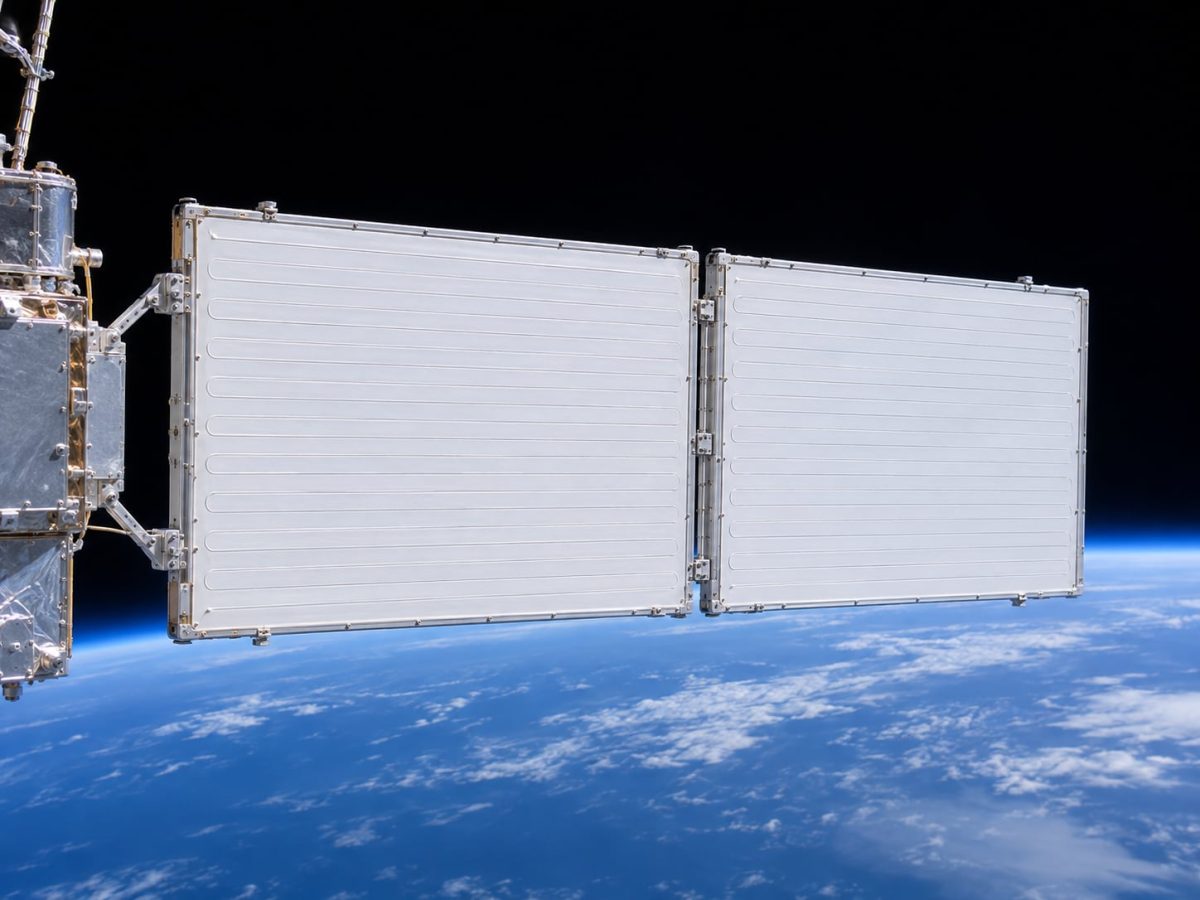
That leaves radiation. NASA’s guide to small spacecraft thermal control defines a radiator as a dedicated surface for dissipating excess heat through radiative heat transfer, typically to deep space. Inside the satellite, heat pipes or fluid loops carry the heat from the electronics to that surface. Then it can only leave as infrared light.
Let’s do the math
Radiation follows the Stefan-Boltzmann law. The power a surface sheds depends on its temperature raised to the fourth power. We can use it for a rough estimate.
A perfect radiating surface at 300 kelvin, about 27°C or 80°F, gives off roughly 460 watts per square meter. A good real coating might reach about 90 percent of that, or around 410 watts. A flat panel radiating from both sides doubles it to around 820 watts per square meter of panel.
So one megawatt of computing, which is a modest amount for AI, would need about 1,200 square meters of panel. That is close to three NBA basketball courts of radiator, and that is before counting sunlight and the warm Earth shining on it. A gigawatt, the unit people now use for large campuses on the ground, would be a thousand times more.
This estimate is deliberately simple, but the shape of the problem is clear: heat rejection scales with area, and area in orbit means mass, launch cost and more structure to keep rigid.
The fourth-power escape hatch
That fourth power offers one way out. Run the radiator hotter and it sheds heat much faster. At 350 kelvin, about 77°C, a perfect surface gives off about 850 watts per square meter, close to double the figure at 300 kelvin, for a rise of only 50 degrees.
Chips, however, have temperature limits, and heat has to flow downhill from the chip to the radiator. So every degree you gain at the radiator pushes you closer to the limit at the silicon. Radiator designers and chip designers end up negotiating over the same few degrees, and that trade sits at the center of any orbital compute concept. Even Google’s team lists thermal management as a significant engineering challenge still to be solved.
The other problems on the list
- Radiation. Outside most of the atmosphere’s protection, energetic particles can flip bits in memory and slowly wear down electronics. Hardware has to tolerate it or correct for it. Google says its prototype mission will test how its TPU hardware behaves in space.
- Talking to each other. AI work needs huge bandwidth between chips. Satellites flying in tight formation would rely on optical links, essentially lasers between spacecraft, which also need to be proven at scale.
- Repairs. On Earth, a technician swaps a dead part. In orbit, nobody is coming. Designs have to assume failures and work around them.
- Launch. Google’s analysis suggests prices may fall to under $200 per kilogram by the mid-2030s, which is the sort of number that makes the economics start to look possible. That is a projection, not a price list.
So is this real?
It is a real research program with serious unknowns. Google plans a learning mission with Planet to launch two prototype satellites by early 2027, testing how its hardware operates in orbit and validating optical links. A prototype is a long way from a gigawatt, and honest proponents present this as a bet on the next decade, not a fix for this year’s power shortage.
It may also turn out to be most useful in a narrower way. Processing data that is already in space, such as Earth observation images, avoids sending it all down to the ground. Niche jobs like that could prove out the hardware well before anyone trains a frontier model above the clouds.
What to watch
When the next announcement lands, skip the renderings and ask three questions. How much radiator area is there per kilowatt of computing? What temperature does it run at? And has any of it been flown? If the answers are vague, you are looking at a concept, not a data center.