Good morning. Five stories, five minutes. Today’s thread: the most interesting machines right now are the patient ones, built to grind through a long job instead of answering fast.
A model that stays on the job for days
Google’s Gemini 4 Carbon arrived just two weeks after Gemini 4 Argon, and it has a specific personality: stubbornness. It is built for workflows that run for days, hitting dead ends and backing out until it finds a subtle bug in a huge codebase. Google says the Chrome team saw patches ten times better than other leading models produced.
That same skill is useful to attackers, so access starts with a small group of cyber defenders through the Fairwind Program. Worth noting: the “ten times” figure is an internal report, not an outside test. The price for those who get in later starts at $2 per million input tokens and $10 per million output tokens.
Source: The New Digital Sentry: Google Unveils Cybersecurity Powerhouse Gemini 4 Carbon
Private computing finally gets a fast lane
Fully homomorphic encryption lets a computer work on data it cannot read. Lovely idea, painfully slow in practice, since it runs thousands of times slower than working on raw data. Intel’s new Heracles chip goes after that gap directly, claiming speeds up to 5,000 times faster than top server CPUs.
In one simulation, a verification job that would take a Xeon more than 17 days finished in 23 minutes. If that holds up outside the demo, sensitive work like genetic analysis could run in the cloud without the cloud ever seeing the data.
Source: Intel Breaks the Privacy Bottleneck With New High Speed Encryption Hardware
Six gigawatts, one desert county
Residents of Cochise County, Arizona packed an elementary school to hear about a proposed AI campus: nine buildings on about 747 acres, drawing up to six gigawatts at full capacity. SpaceX led the meeting, but the application was filed by Tombstone Resources LLC, and the link between the two was not explained.
Developers are offering dry cooling to ease water worries. Neighbors are also asking about noise and wildlife. The county’s planning commission is due to hold a public hearing on December 9.
Source: High Tech Ambitions Clash With Rural Concerns In Arizona Desert
Humanoids meet the balance sheet
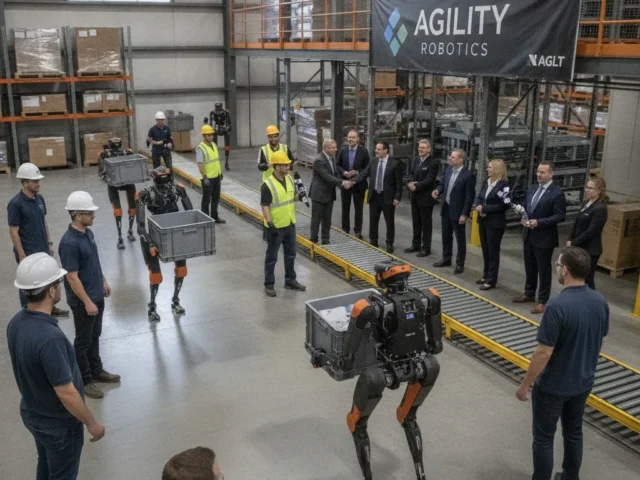
Agility Robotics is heading to the Nasdaq through a merger with a blank-check company, and the paperwork is a useful reality check. The maker of the two-legged Digit robot reported more than $138 million in losses last year against about $1.8 million in revenue.
The bull case rests on Digit 5, designed to work near people without safety barriers, and on a claimed order for 1,000 robots if delivery targets are met by late 2027. Shipping real robots, it turns out, is a much harder story to tell than promising them.
Source: Betting Big on Bipedal Labor as Agility Robotics Hits the Market
Nothing is building AI hardware for your desk
Carl Pei says Nothing will launch its first AI-native device this December, with a teaser that promises “no new screen.” After the Humane AI Pin and Rabbit R1 stumbled, Pei is skipping the pendant-and-glasses route and aiming at work instead, arguing that big shifts start in productivity.
His phrase to remember is “context gap”: models are powerful but know little about your actual day. How the device closes that gap is still unconfirmed, so keep your wallet closed until there are specs.
Source: Nothing Bets on the Office Rather Than the Pocket With New AI Hardware